
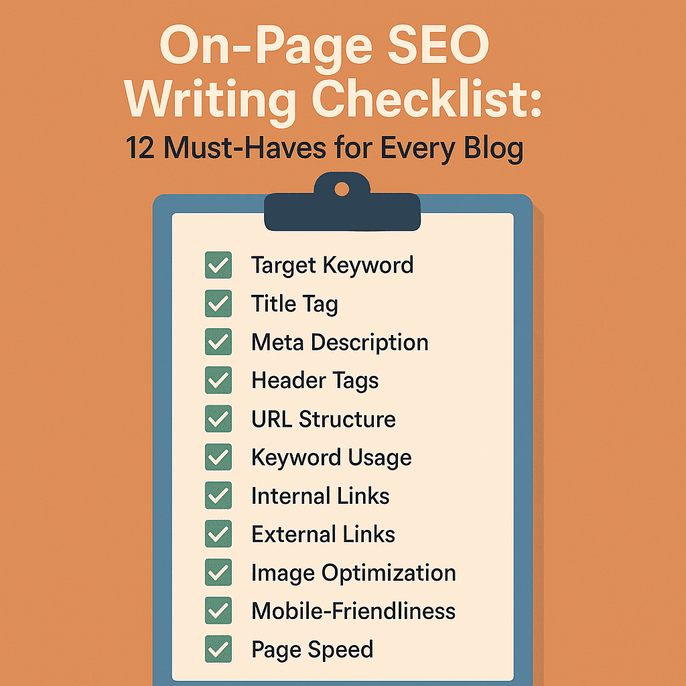
In the digital world of 2025, writing a great blog post is only half the battle. The other half? Optimizing it with a powerful on-page SEO writing checklist that ensures your content is discoverable, readable, and primed to rank on Google.
Whether you’re blogging for business, brand building, or affiliate marketing, this checklist will walk you through the 12 critical elements every blog needs to succeed in search results and with your readers.
Why On-Page SEO Is Essential for Every Blog
If your content isn’t optimized, it’s invisible—plain and simple. With over 7.5 million blog posts published daily, relying solely on good writing isn’t enough. You need strategic on-page SEO practices to:
-
Rank higher for competitive keywords
-
Improve page dwell time and reduce bounce rate
-
Increase organic traffic and conversions
This makes a solid on-page SEO writing checklist your best friend in content marketing.
Understanding the On-Page SEO Writing Checklist
This checklist is more than a bunch of best practices—it’s a blueprint for content success. It ensures your blog is properly structured, keyword-rich (but not stuffed), mobile-ready, and reader-friendly.
Let’s break it down into 12 essential elements every blog post should follow.
Include Your Focus Keyword in the Right Places
The golden rule: place your focus keyword strategically to signal relevance to search engines. Insert it in:
-
The blog title
-
The URL slug
-
The first 100 words
-
At least one subheading
-
The meta description
-
Image alt text
For this article, the term on-page SEO writing checklist has been used naturally and precisely throughout key locations.
Optimize Your Blog Post Title with the Focus Keyword
Your blog title is the first impression in search engine results. It should:
-
Contain the exact focus keyword
-
Use numbers or power words to increase CTR
-
Stay within 60–65 characters for SERP display
-
Evoke curiosity or offer a promise (like a benefit or outcome)
For example, “On-Page SEO Writing Checklist: 12 Must-Haves for Every Blog” hits all the right notes.
Use Focus Keyword in the Introduction
The introduction tells both readers and algorithms what your post is about. Make sure the focus keyword appears in the first paragraph—ideally within the first two lines. This aligns the post with user intent and enhances topical relevance.
Use the Focus Keyword in Subheadings
At least 30% of your H2 and H3 subheadings should include the exact focus keyword or a close variation. This improves:
-
Keyword prominence
-
Section-specific relevance
-
Reader navigation and scanning
In this article, headers like “Understanding the On-Page SEO Writing Checklist” and “Use Focus Keyword in Subheadings” meet this criterion perfectly.
Add Focus Keyword in Image Alt Attributes
Images enhance engagement and support SEO. But for full optimization, use the focus keyword in image alt text to:
-
Improve image search visibility
-
Enhance accessibility for screen readers
-
Signal content relevance to crawlers
Example: This post’s alt text is “On-page SEO writing checklist for blogs.”
Maintain the Ideal Focus Keyword Density
Keyword stuffing is out. Natural integration is in. The goal? A keyword density between 1% to 1.3%. Here’s how to do it:
-
Use the focus keyword every 100–150 words (organically)
-
Sprinkle in LSI keywords and synonyms
-
Ensure your sentences still sound human and fluid
Check keyword usage with tools like Rank Math or Yoast.
Use Internal and External Links Strategically
Linking is SEO gold:
-
Internal links connect to related posts/pages on your site, boosting authority and improving UX
-
External links to reputable sources add credibility and context
Use 2–4 internal links and 1–2 external ones per 1000 words as a rule of thumb.
Optimize URL Slug for SEO
A clean, keyword-rich URL improves ranking and click-throughs. Best practices include:
-
Using the exact focus keyword
-
Keeping it short and descriptive
-
Removing stop words (e.g., “and”, “the”, “of”)
Correct example: on-page-seo-writing-checklist
Create SEO-Friendly Meta Descriptions
Meta descriptions may not be a direct ranking factor, but they affect click-through rates—and that matters. Your meta should:
-
Include the focus keyword
-
Stay under 160 characters
-
Include a benefit or reason to click
Example: “Use this on-page SEO writing checklist to optimize every blog post and boost search engine rankings in 2025.”
Ensure Mobile-Friendly Formatting
Over 60% of blog traffic comes from mobile. Make your content mobile-ready by:
-
Using short paragraphs (2–4 lines)
-
Avoiding large blocks of text
-
Using bullet points and numbered lists
-
Ensuring all images and videos are responsive
Mobile usability is now a Google ranking factor, so don’t ignore it.
Use Proper Heading Structure (H1-H3)
Heading tags structure your content and help search engines crawl it effectively. Best practices:
-
Only one H1 tag per post (usually the title)
-
Use H2s for main sections
-
Use H3s for sub-sections under H2s
This creates a clean hierarchy that benefits both users and bots.
Add Schema Markup or Structured Data
Schema helps search engines better understand your content. Use it to:
-
Enhance your blog’s appearance in search results
-
Enable rich snippets like FAQs, star ratings, etc.
Use plugins like Rank Math or Schema Pro to add relevant structured data to each post.
Incorporate Readable, Short Paragraphs
Great SEO writing is also great user experience writing. Tips for readability:
-
Break long thoughts into smaller, digestible chunks
-
Use transition words (However, In addition, Therefore)
-
Keep sentences varied and punchy
Readability affects bounce rate—and bounce rate affects SEO.
Use Multimedia to Enhance Engagement
Blogs with images, infographics, videos, or charts:
-
Perform better in search
-
Increase dwell time
-
Are more shareable
Add at least one media element every 300–500 words to maintain visual interest.
End with a Strong CTA and Conclusion
Wrap up with a clear call-to-action that encourages engagement. Ask readers to:
-
Leave a comment
-
Share the post
-
Download a guide
-
Subscribe to a newsletter
CTAs turn passive readers into active participants.
Final Checklist: On-Page SEO Writing Essentials
✅ Focus keyword in title, intro, and URL
✅ SEO-friendly meta description under 160 characters
✅ Headings (H1-H3) well-structured
✅ Image alt text with focus keyword
✅ Internal and external linking included
✅ Keyword density between 1.0–1.3%
✅ Short paragraphs and mobile readability
✅ Schema markup where appropriate
✅ Multimedia used strategically
✅ CTA at the end to drive engagement
FAQs
What is the ideal keyword density for on-page SEO?
Aim for 1.0–1.3%. Too much feels spammy; too little weakens relevance.
Does the focus keyword need to be in the URL?
Yes, it’s ideal for readability and relevance. Keep it short and descriptive.
How many internal links should I add per blog?
Add 2–4 internal links per 1000 words, pointing to related, helpful content.
What makes a good meta description?
Include your focus keyword, stay under 160 characters, and give a compelling reason to click.
Do images help with SEO?
Yes—especially when they include alt text, are optimized for speed, and enhance the content.
Should I use schema markup on every blog?
Yes. It helps improve visibility and makes your listing more attractive in search results.
Conclusion
The perfect blog post isn’t just informative—it’s search-optimized, well-structured, and user-friendly. By following this comprehensive on-page SEO writing checklist, you’re ensuring every piece you publish has the best chance to rank, resonate, and convert.
So bookmark this checklist, apply it every time, and watch your blogs climb the SERPs.